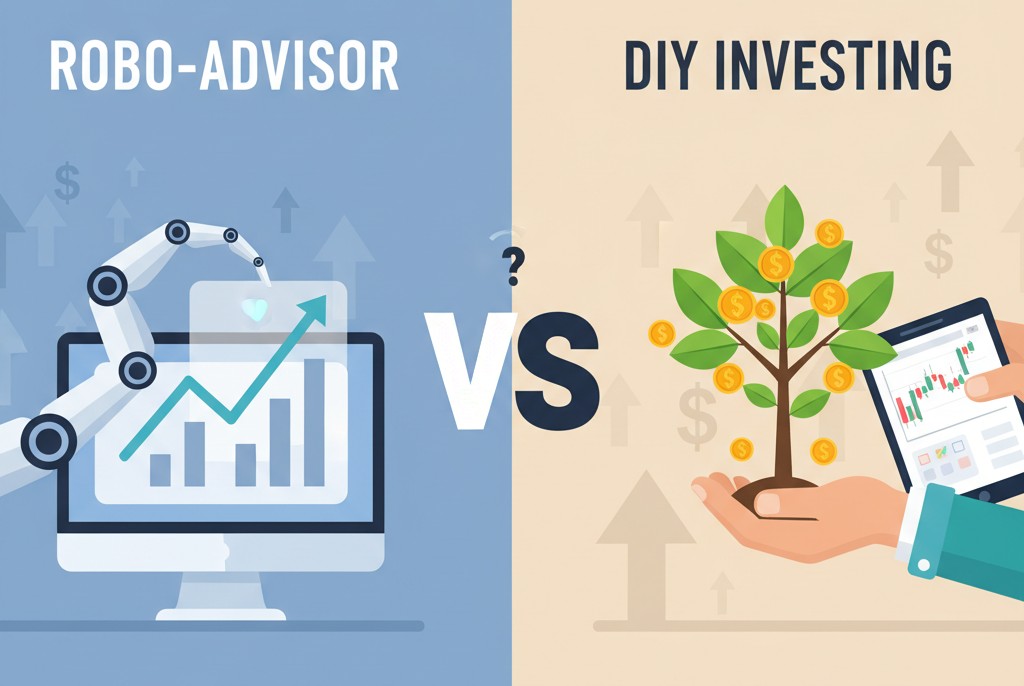
Robo-Advisor vs. DIY Investing: Which Path Is Right for Your First $10,000?
Introduction
You’ve saved your first $10,000—a milestone that shifts your financial focus from simply saving to strategically growing. But this new chapter brings a paralyzing question: what is the smartest way to invest? You’re caught between two compelling paths: the sleek, automated promise of a robo-advisor or the hands-on, educational journey of Do-It-Yourself (DIY) investing. This isn’t just a technical choice; it’s a decision about the role you want money to play in your life. This guide will provide a clear framework to move past the analysis paralysis, helping you choose the right path not just for your money, but for your mindset.
The Two Contenders: A Modern Financial Duel
Before we dissect the strategies, let’s clearly define our two contenders. Think of it as choosing between a high-tech personal trainer and building your own gym.
A Robo-Advisor is like a personal trainer for your investments. You tell it your goals (e.g., retiring in 40 years, saving for a down payment), and it designs and manages a diversified workout plan (your portfolio) for you, automatically adjusting as needed. It’s a service designed for efficiency and discipline.
DIY Investing is like building your own home gym. You research the equipment (stocks, bonds, ETFs), design your own workout routines (asset allocation), and are solely responsible for your progress and adjustments. It requires more effort and knowledge but offers complete control and a potentially deeper understanding of your own financial fitness.
The Four Pillars of Decision: A Head-to-Head Analysis
Your choice hinges on four critical factors: Cost, Time Commitment, Emotional Control, and Diversification. Let’s see how each path stacks up.
1. Cost: The Visible and Invisible Price of Investing
Fees are the silent friction that can slow your portfolio’s growth. A 1% difference in fees might seem trivial, but over 30 years, it can consume nearly 28% of your potential returns.
- Robo-Advisors: They charge an annual management fee, typically ranging from 0.25% to 0.50% of your assets. For a $10,000 portfolio, this is about $25 to $50 per year. This fee is for the platform’s service of automatic rebalancing and management. On top of this, you pay the small fees embedded in the ETFs they choose for you (the expense ratio), which are usually very low (0.03% to 0.15%). The total cost is transparent and predictable.
- DIY Investing: The direct cost can be close to zero. Most major brokerages like Fidelity and Schwab now offer $0 commissions for stock and ETF trades. Your only direct cost is the expense ratio of the ETFs or mutual funds you choose. For a DIY investor mirroring a robo-advisor’s portfolio, the cost is just the expense ratio. However, the *invisible* costs can be higher: the cost of making a bad trade, the time spent on research, or the failure to rebalance properly.
[CHART: Annual Cost Comparison on a $10,000 Investment: Robo-Advisor (0.35% all-in) vs. DIY (0.05% ETF expense ratio)]
2. Time Commitment: The Sweat Equity of Growth
Your time is a valuable asset. How much of it are you willing to invest in your investments?
- Robo-Advisors: The initial setup takes less than an hour. After that, the time commitment is minimal—perhaps an hour or two per year for a check-in. The service handles the research, trading, and rebalancing. This is the core value proposition: they give you back your time.
- DIY Investing: The initial learning curve is steep. Expect to spend dozens of hours understanding basic concepts like asset allocation, risk tolerance, and security analysis. Ongoing, a diligent DIY investor might spend 5-10 hours per month monitoring their portfolio and researching opportunities. This is a significant, long-term commitment.
3. Emotional Control: The Battle Against Your Own Brain
The biggest threat to long-term returns isn’t the market; it’s the investor’s own emotional reactions. The urge to sell during a panic or buy into a speculative bubble is a powerful, wealth-destroying force.
- Robo-Advisors: They are your behavioral guardrails. By automating investment decisions, they remove the panic button from your dashboard. When the market drops, the algorithm is programmed to see it as a potential rebalancing opportunity, not a reason to flee. This disciplined, unemotional approach is one of their most underrated features.
- DIY Investing: You are your own behavioral coach. It requires immense discipline to stick to your strategy when headlines are screaming about a market crash. While some thrive on this control, many beginners find it difficult to separate emotion from action, leading to classic mistakes. The robo-advisor pros and cons often boil down to this single point: are you disciplined enough to manage your own psychology?
4. Diversification & Strategy: The Blueprint for Your Money
Diversification is the principle of not putting all your eggs in one basket. Both approaches achieve this, but with different philosophies.
- Robo-Advisors: They provide instant, algorithm-driven diversification based on Modern Portfolio Theory. They use a mix of low-cost ETFs across various asset classes (US stocks, international stocks, bonds, etc.). The strategy is sound, academically backed, and tailored to your stated risk tolerance. You can’t, however, easily decide to overweight a specific sector you believe in.
- DIY Investing: You have infinite flexibility. You can build a core portfolio of broad market ETFs and then add satellite positions in specific sectors or companies you’ve researched. This allows for a more personalized strategy but also opens the door to concentration risk or “diworsification”—adding assets that don’t actually improve your risk-adjusted returns. Answering the question `is DIY investing hard` often comes down to the complexity of building and maintaining a truly diversified portfolio.
Which Investor Persona Are You?
The best choice depends on your personality. Find yourself in one of these three personas.
1. The Hands-Off Investor (“The Automator”)
You see investing as a crucial but technical task that should be handled as efficiently as possible. You value your time highly and would rather spend it on your career, family, or hobbies than on financial research. For you, the fee paid to a robo-advisor is a small price for peace of mind and professional management.
Verdict: Robo-Advisor is your ideal co-pilot.
2. The Eager Learner (“The Apprentice”)
You are fascinated by the markets and see investing as a critical life skill you want to master. You’re willing to put in the “sweat equity” of learning and enjoy the process of research and analysis. You believe the knowledge gained from managing your own money is an asset in itself.
Verdict: DIY Investing is your path to mastery. Start with a simple, broad-market ETF portfolio to learn the ropes.
3. The Cost-Minimizer (“The Optimizer”)
You are laser-focused on minimizing fees and maximizing every basis point of return. You understand the corrosive effect of costs over the long term and are comfortable enough with the basics to replicate a robo-advisor’s portfolio on your own using zero-commission ETFs. You might compare `Wealthfront vs Fidelity` not on features, but purely on the total cost of ownership.
Verdict: A simple DIY portfolio is your optimal solution. A three-fund portfolio (Total US Stock Market, Total International Stock Market, Total Bond Market) can be set up in an afternoon and will outperform most high-fee strategies over the long run.
Conclusion: Your First Move is the Most Important
The debate between robo-advisors and DIY investing isn’t about finding a single “best” answer, but about finding the best answer *for you, right now*. For many beginners, a robo-advisor is a superb entry point. It gets you invested in a diversified, low-cost portfolio while preventing the classic emotional mistakes that can derail a new investor. You can always graduate to a DIY approach later, armed with more knowledge and experience.
Conversely, if you have the discipline and desire, the DIY path offers a rewarding journey of lifelong learning and complete control. The most critical insight is this: the potential gains lost by waiting on the sidelines in “analysis paralysis” are far greater than the marginal differences between these two excellent starting strategies. Choose your path, take the first step, and let the power of compounding begin its work.
This article is for informational purposes only and should not be considered financial advice.