5 Tariff-Proof Stocks to Fortify Your Portfolio in 2025
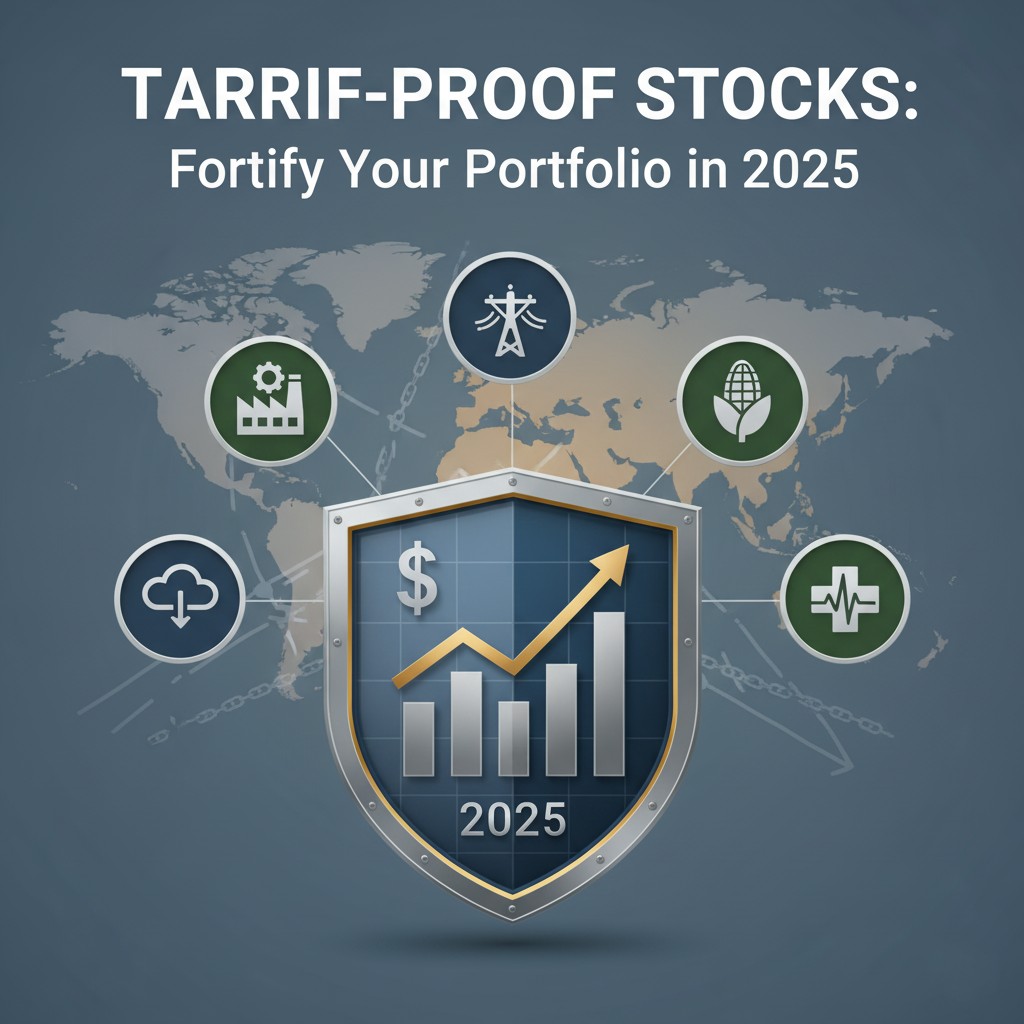
In a world of escalating trade tensions and fragile supply chains, does your investment portfolio feel caught in the crossfire? Every headline about new tariffs or geopolitical friction can feel like a direct hit to your net worth. But what if you could build a financial fortress, structurally insulated from the storms of the US-China trade war? This isn’t about timing the market or predicting political outcomes; it’s about strategically choosing companies that operate outside the battlefield.
This guide will reveal five such companies—”tariff-proof” stocks poised for resilience. These are businesses whose fortunes are tied not to volatile international trade, but to the enduring strength of the domestic economy. We will provide a detailed analysis of why each one is uniquely positioned to thrive in 2025 and beyond, regardless of the geopolitical climate.
The Fortress Strategy: Investing in Domestic Resilience
Imagine building a castle. You could import exotic marble from a distant land, but your supply line could be cut off by pirates or blockades at any moment. The smarter move is to build with stone from a local quarry—it’s reliable, accessible, and immune to foreign disruption. This is the core of our investing during trade war strategy. Instead of focusing on companies entangled in global supply chains, we turn to those built on a bedrock of domestic demand.
Our selection process for these “fortress stocks” is rigorous, based on three core principles:
- Minimal China Exposure: The company derives a negligible portion of its revenue from China and does not depend on the region for critical supplies.
- Dominant Domestic Demand: The primary market is the United States, driven by American consumers and businesses. These are true domestic demand stocks.
- Durable Competitive Advantage: The company has a strong “moat,” such as brand power, network effects, or regulatory barriers, allowing it to weather economic downturns.
Let’s analyze the five companies that meet these criteria.
1. Waste Management, Inc. (NYSE: WM)
Why It’s Resilient
Waste Management is the quintessential domestic business. Its operations—trash collection, recycling, and landfill management—are, by their very nature, local. The company’s vast network of landfills and transfer stations creates a powerful geographic moat that is nearly impossible for a foreign competitor to replicate. Tariffs on steel or semiconductors are irrelevant to a company whose primary assets are land and trucks operating within the United States. As reported by their latest filings, over 95% of WM’s revenue is generated in North America, making it one of the most effective companies not affected by China tariffs.
“Waste Management’s business is as essential as running water and electricity. It’s a non-discretionary service, providing a steady, predictable revenue stream immune to global trade disputes.”
For a deeper dive into analyzing company fundamentals, see our guide. [Internal Link: How to Read a Balance Sheet]
2. Union Pacific Corporation (NYSE: UNP)
Why It’s Resilient
If a product is made and consumed in America, chances are Union Pacific moves it. As one of the two major railroad operators in the Western United States, UNP is a vital artery of the domestic economy. Its business is the movement of goods like grain, chemicals, and finished products across the vast expanse of the country. While the *contents* of its freight cars might originate from overseas, UNP’s revenue is generated from the domestic transport itself. A trade war might change the mix of goods, but it won’t eliminate the need for them to be moved from a port in California to a factory in Illinois. This focus on the domestic leg of the supply chain provides a powerful buffer against supply chain risk investing concerns.
“Railroads are the backbone of the domestic economy. Union Pacific doesn’t just move goods; it connects the fabric of American industry, a role that remains critical regardless of international trade policies.”
Data on domestic freight volumes can be cross-referenced with official statistics. [External Link: U.S. Department of Transportation Freight Analysis]
3. The Sherwin-Williams Company (NYSE: SHW)
Why It’s Resilient
Paint is heavy, bulky, and expensive to ship across oceans. This simple fact gives Sherwin-Williams a formidable defense against foreign competition and trade disputes. The company dominates the U.S. paint and coatings market through its vast network of over 4,700 stores, serving everyone from individual homeowners to large-scale construction contractors. Its supply chain is vertically integrated and heavily focused on the Americas. When the U.S. housing market or construction industry is active, Sherwin-Williams prospers, making it a direct play on American economic health, not global trade flows.
“Sherwin-Williams has painted itself into a corner of the market that is structurally protected from globalization. Its value is in its proximity to the customer.”
Understanding market positioning is key. [Internal Link: Building a Moat: Competitive Advantages Explained]
4. Chipotle Mexican Grill (NYSE: CMG)
Why It’s Resilient
You can’t tariff a burrito. Chipotle’s business model is inherently local: it operates thousands of restaurants primarily in the United States and has made a public commitment to sourcing ingredients from local and domestic farms whenever possible. Its “Food with Integrity” ethos is not just a marketing slogan; it’s a business strategy that shortens its supply chain and insulates it from international price shocks and tariffs. The company’s success is tied to U.S. consumer spending and dining trends, not the complex web of global manufacturing. This makes it a prime example of a business that can create a resilient portfolio 2025 can depend on.
“Chipotle’s success is a testament to the power of the domestic consumer. It thrives by serving American tastes with ingredients sourced from American farms.”
For more on consumer trends, consult reports from leading research firms. [External Link: The Conference Board Consumer Confidence Index]
5. Berkshire Hathaway Inc. (NYSE: BRK.B)
Why It’s Resilient
Investing in Berkshire Hathaway is, in many ways, a diversified bet on the U.S. economy itself. While it holds stakes in international companies like Apple, its core, wholly-owned businesses are deeply American. Think of its massive insurance operations (GEICO), its railroad (BNSF, a direct competitor to UNP), and its utility and energy divisions (Berkshire Hathaway Energy). These are capital-intensive, highly regulated, and essential services rooted firmly in American soil. Warren Buffett has long favored businesses with durable, domestic-focused models, creating a conglomerate that is a fortress against many forms of global uncertainty, including trade wars.
“Berkshire Hathaway is less a single stock and more a cross-section of the most durable parts of the American economy. It is a ready-made domestic fortress.”
Learn more about Berkshire’s unique structure. [Internal Link: Understanding Conglomerates]
Conclusion: A Shift in Perspective
Building a “tariff-proof” portfolio is not a defensive crouch but a proactive pivot. It’s an acknowledgment that in an era of geopolitical realignment, the most reliable growth may be found here at home. The five companies analyzed—Waste Management, Union Pacific, Sherwin-Williams, Chipotle, and Berkshire Hathaway—are more than just stocks. They are pillars of the domestic economy, offering a compelling combination of resilience and long-term potential.
By focusing on businesses with minimal foreign exposure and strong domestic demand, you can fortify your portfolio against the headline risks of tomorrow and invest with confidence in the enduring strength of the American economic engine.
This article is for informational purposes only and should not be considered financial advice.