Bond ETFs Explained in 5 Minutes (The Smart Way to Diversify Beyond Stocks)
You’ve built a solid foundation with stocks, but you keep hearing the same piece of advice from seasoned investors: “Don’t put all your eggs in one basket.” You know you need to diversify, and the word “bonds” keeps coming up as the key to stability. But let’s be honest: the world of individual bonds, with its jargon of coupons, maturities, and credit ratings, can feel like a locked room for the average investor. What if there was a key? What if you could own hundreds of different bonds in a single, simple investment?
That key exists, and it’s called a Bond ETF. This guide will demystify this powerful tool in under five minutes, showing you the smartest way to add the stabilizing power of bonds to your portfolio without the headache.
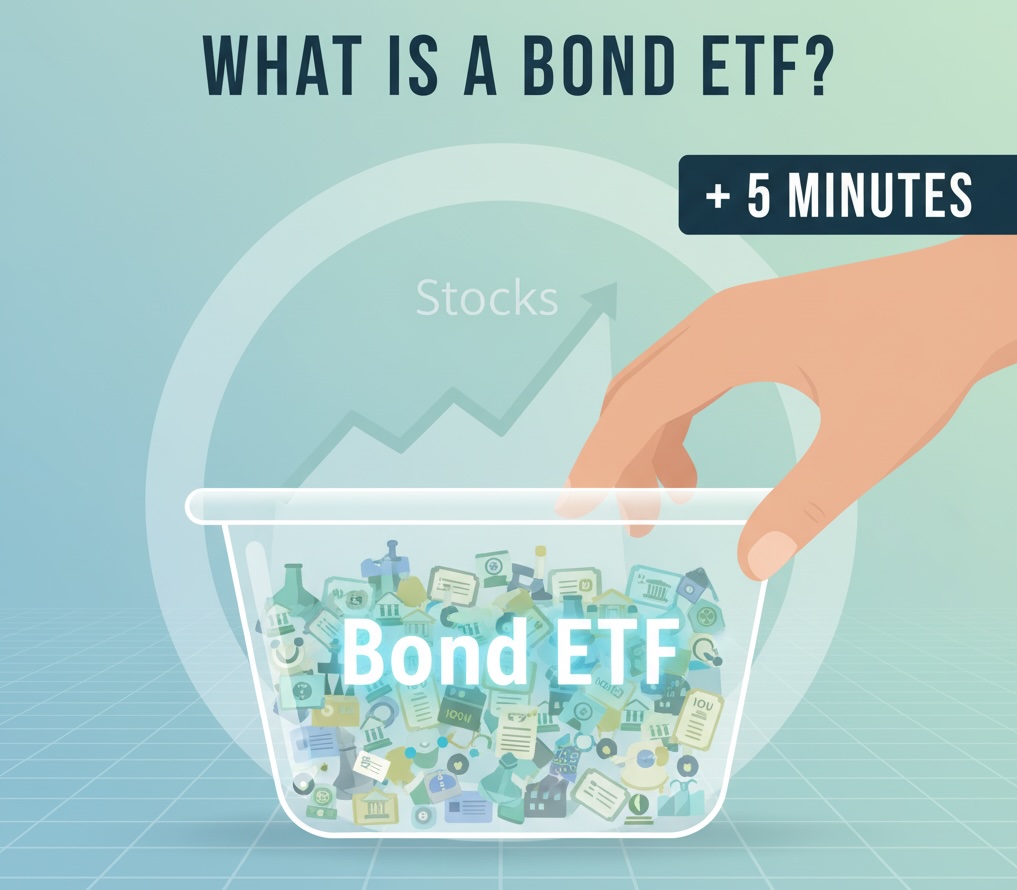
What is a Bond ETF? The “Basket of Loans” Analogy
Imagine you have some money you’re willing to lend out. Instead of lending it all to one person, you decide to put it into a large basket. This basket, in turn, distributes your money as tiny loans to hundreds of different entities—governments of stable countries, blue-chip corporations, and growing municipalities.
That basket is your bond ETF.
A bond is essentially a loan made by an investor to a borrower. A Bond ETF (Exchange-Traded Fund) is a fund that buys and holds a diversified collection of these bonds. When you buy a share of a bond ETF, you are buying a small piece of every single bond—every single loan—in that basket. You receive your share of the interest payments (often paid out as monthly or quarterly dividends) and your principal is diversified across all the borrowers.
In essence, a bond ETF turns you from a single lender into a diversified lending institution, instantly spreading your risk across a vast landscape of borrowers. It’s the difference between betting on one horse and betting on the entire race.
How Do Bond ETFs Actually Work?
Understanding how bond ETFs work is simpler than you think. It boils down to three core concepts: Diversification, Liquidity, and Income.
1. Instant Diversification
Buying a single bond from one company is a concentrated risk. If that company faces financial trouble, your entire investment is at stake. A bond ETF, however, might hold bonds from hundreds or even thousands of different issuers.
This built-in diversification is a core benefit. The potential default of one or even several borrowers has a minimal impact on the overall value of the fund. This is a foundational principle of risk management, and bond ETFs deliver it automatically. For more on this, see our guide on
2. Stock-Like Liquidity
Individual bonds are notoriously illiquid. Selling one before its maturity date can be a slow and costly process. Bond ETFs, however, trade on major stock exchanges just like a share of Apple or Amazon. You can buy and sell them throughout the trading day at a market-determined price.
This liquidity gives you flexibility. If you need to access your capital or want to adjust your portfolio, you can do so with a few clicks on your brokerage platform.
3. A Stream of Regular Income
The underlying bonds in the ETF’s portfolio generate interest payments, known as “coupon” payments. The fund collects all this interest, bundles it together, and distributes it to its shareholders, typically on a monthly or quarterly basis. This provides a predictable stream of income, which can be a powerful tool for cash flow or for reinvesting to compound your returns.
Key Takeaway Box: Bond ETF vs. Individual Bonds
- Complexity: Buying individual bonds requires significant research. A bond ETF is a single-click investment.
- Diversification: An individual bond is a single risk. A bond ETF is a portfolio of hundreds of risks, drastically reducing concentration.
- Cost: You may need a large amount of capital to build a diversified portfolio of individual bonds. You can buy a single share of a bond ETF for a much lower price.
Are Bond ETFs a Good Investment for You?
While no investment is without risk, bond ETFs are often considered a cornerstone for building a resilient, long-term portfolio. The key question is not if you should consider them, but how they fit into your personal financial goals.
Historically, bonds have often had a low or negative correlation with stocks. As data from the Federal Reserve shows, during periods of stock market volatility, high-quality government bonds have tended to hold their value or even appreciate, acting as a stabilizing force.
If your goal is to reduce the overall volatility of your portfolio, generate a steady stream of income, or simply preserve capital while earning a modest return, then a bond ETF is one of the most efficient tools at your disposal.
Conclusion: The Intelligent Path to Stability
The world of investing can feel unnecessarily complex, but the most powerful strategies are often the simplest. The bond ETF is a testament to this. It takes the time-tested principle of bond investing—lending money for a predictable return—and makes it accessible, liquid, and intelligently diversified for the modern investor.
It is more than just an investment product; it’s a strategic tool. It’s the “smart way” to diversify beyond stocks, not because it promises explosive growth, but because it delivers something just as valuable: stability and peace of mind. By understanding a bond ETF as a simple “basket of loans,” you’ve already grasped the most important concept. You are now equipped to take the next step in building a truly balanced and resilient financial future.
This article is for informational purposes only and should not be considered financial advice.