The Investor’s Guide to Year-End Tax-Loss Harvesting (and the Wash-Sale Rule to Avoid)
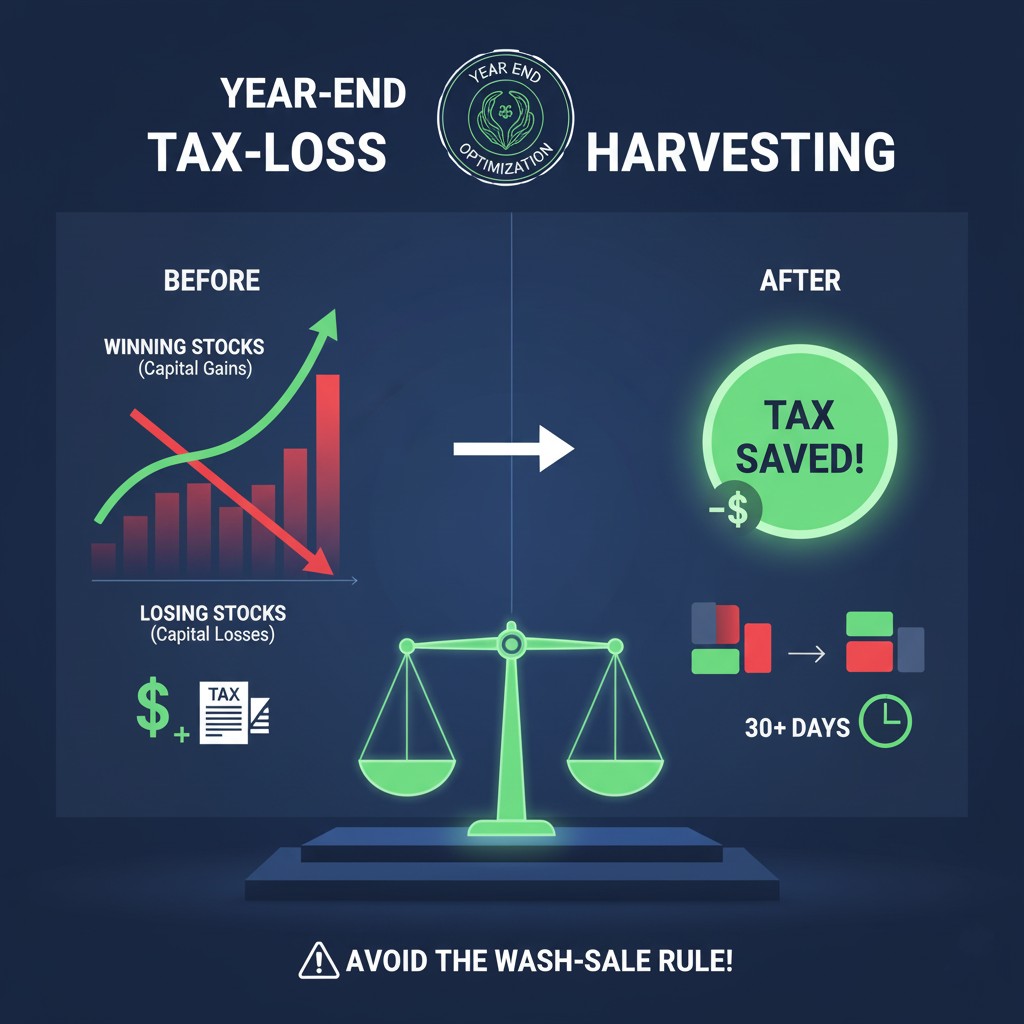
You’ve had a good year in the market, with many of your investments showing healthy gains. But a few positions are stubbornly in the red. As you prepare to close the books on the year, your instinct might be to ignore them and focus on the winners. But what if you could turn those losers into a winning tax strategy? This isn’t about alchemy; it’s about a powerful, IRS-sanctioned technique called tax-loss harvesting. For savvy investors, it’s one of the most effective tools available to reduce investment taxes. This guide will demystify the process with a simple, real-world example and, most importantly, show you how to sidestep the one critical mistake that trips up countless investors: the wash-sale rule.
What is Tax-Loss Harvesting? The Silver Lining Playbook
In short, tax-loss harvesting is the practice of selling an investment at a loss to lower your tax bill. The realized loss from that sale can be used to offset capital gains you’ve realized from selling other, profitable investments. If your losses exceed your gains, you can use up to $3,000 of the excess loss to reduce your ordinary income (like your salary), which is taxed at a higher rate. Any remaining losses can be carried forward to future years. It’s a way of finding a silver lining in a poorly performing investment.
A Tale of Two Investors: A Simple Example
The best way to understand the power of this strategy is to see it in action. Let’s imagine two investors, Alex and Ben, who each have the same two stocks in their portfolio at year-end.
- Realized Gain from Stock A: +$10,000
- Unrealized Loss from Stock B: -$8,000
Investor Alex (Does Nothing): Alex sees the loss in Stock B and decides to wait for it to recover. He does nothing.
Tax Consequence: Alex must pay capital gains tax on his full $10,000 gain from Stock A.
Investor Ben (Harvests the Loss): Ben decides to use a year end tax loss harvesting strategy. He sells Stock B, “harvesting” the $8,000 loss.
Tax Consequence: The $8,000 loss is used to offset his $10,000 gain. Now, Ben only has to pay capital gains tax on a net gain of $2,000 ($10,000 gain – $8,000 loss).
The Bottom Line: Assuming a 15% long-term capital gains tax rate, Alex pays $1,500 in taxes ($10,000 x 15%). Ben pays only $300 ($2,000 x 15%). By taking action, Ben saved $1,200 in taxes.
The #1 Trap: The Wash-Sale Rule Explained
This strategy sounds great, but there’s one critical rule you must follow: the Wash-Sale Rule. The IRS implemented this to prevent investors from selling a security to generate a tax loss, only to immediately buy it back.
The Rule: A wash sale occurs if you sell a security at a loss and then buy a “substantially identical” security within 30 days *before* or 30 days *after* the sale. This 61-day period is the window you need to watch. If you trigger the wash-sale rule, the IRS disallows your tax loss.
What does “substantially identical” mean?
- Clear Violation: Selling 100 shares of Apple (AAPL) and buying 100 shares of Apple the next day.
- Gray Area (Best to Avoid): Selling the Vanguard S&P 500 ETF (VOO) and buying the iShares S&P 500 ETF (IVV). While technically different funds, they track the exact same index, and the IRS would likely consider them substantially identical.
- Generally Safe: Selling an S&P 500 ETF and buying a Total Stock Market ETF or an international stock ETF. These track different indexes and are not considered substantially identical.
The key to avoiding the wash-sale rule is to wait the full 31 days to buy back the same security, or to immediately replace it with a similar but not identical investment to maintain your desired market exposure.
Your 3-Step Year-End Harvesting Checklist
Ready to put this into practice? The deadline for tax-loss harvesting for most investors is the last business day of the year, December 31, 2025.
- Identify Your Losses: Go through your brokerage account and identify any positions that are currently trading at a loss.
- Identify Your Gains: Look at the investments you’ve already sold for a profit this year. This is the amount you can potentially offset.
- Execute & Replace (Carefully): Sell the losing investment to realize the loss. If you want to maintain a similar position in your portfolio, immediately reinvest the proceeds into a non-identical security (e.g., sell a specific tech stock and buy a broad technology ETF).
Conclusion: Don’t Leave Money on the Table
Tax-loss harvesting is not about market timing or admitting defeat on an investment. It is a disciplined, intelligent strategy to optimize your tax outcome. By systematically turning your portfolio’s “lemons” into tax “lemonade,” you can significantly improve your after-tax returns over the long run. With the year-end deadline fast approaching, now is the time to review your portfolio for these opportunities. If you’re dealing with a complex portfolio, consulting with a financial advisor or using sophisticated tax software can help you execute this strategy flawlessly.
This article is for informational purposes only and should not be considered financial advice. Consult with a qualified professional for advice tailored to your specific situation.