Beyond Savings Accounts: The 5 Best Fixed Income Investments for a Secure Retirement in 2026
You’ve done the hard work of saving for retirement. But now comes the second, equally crucial challenge: making that money last and generate the income you need. In a world where traditional savings accounts often fail to keep pace with inflation, the search for yield without taking on undue risk has become the central task for today’s retiree. Where can you find the safest investments with highest returns?
The answer lies in understanding the world of fixed income—a landscape far richer and more varied than just bank accounts. This guide moves beyond the obvious, providing a clear, no-jargon comparison of the top five fixed income options for 2026. We will help you build a resilient retirement income portfolio by understanding the distinct role each of these tools can play.
The Fixed Income Spectrum: Yield, Safety, and Access
Before we dive into specific investments, it’s vital to understand that “fixed income” is a spectrum. Each option involves a trade-off between three key factors:
- Yield: The return you get on your money.
- Safety: The level of risk to your principal investment.
- Liquidity: How quickly and easily you can access your cash.
Think of it like choosing a container for water. A High-Yield Savings Account is like an open lake: the water is easy to access (high liquidity), but it evaporates quickly under the sun (lower yield). A multi-year annuity is like a sealed, deep reservoir: you can’t touch the water for years (low liquidity), but none of it is lost and it’s there when you need it (guaranteed return).
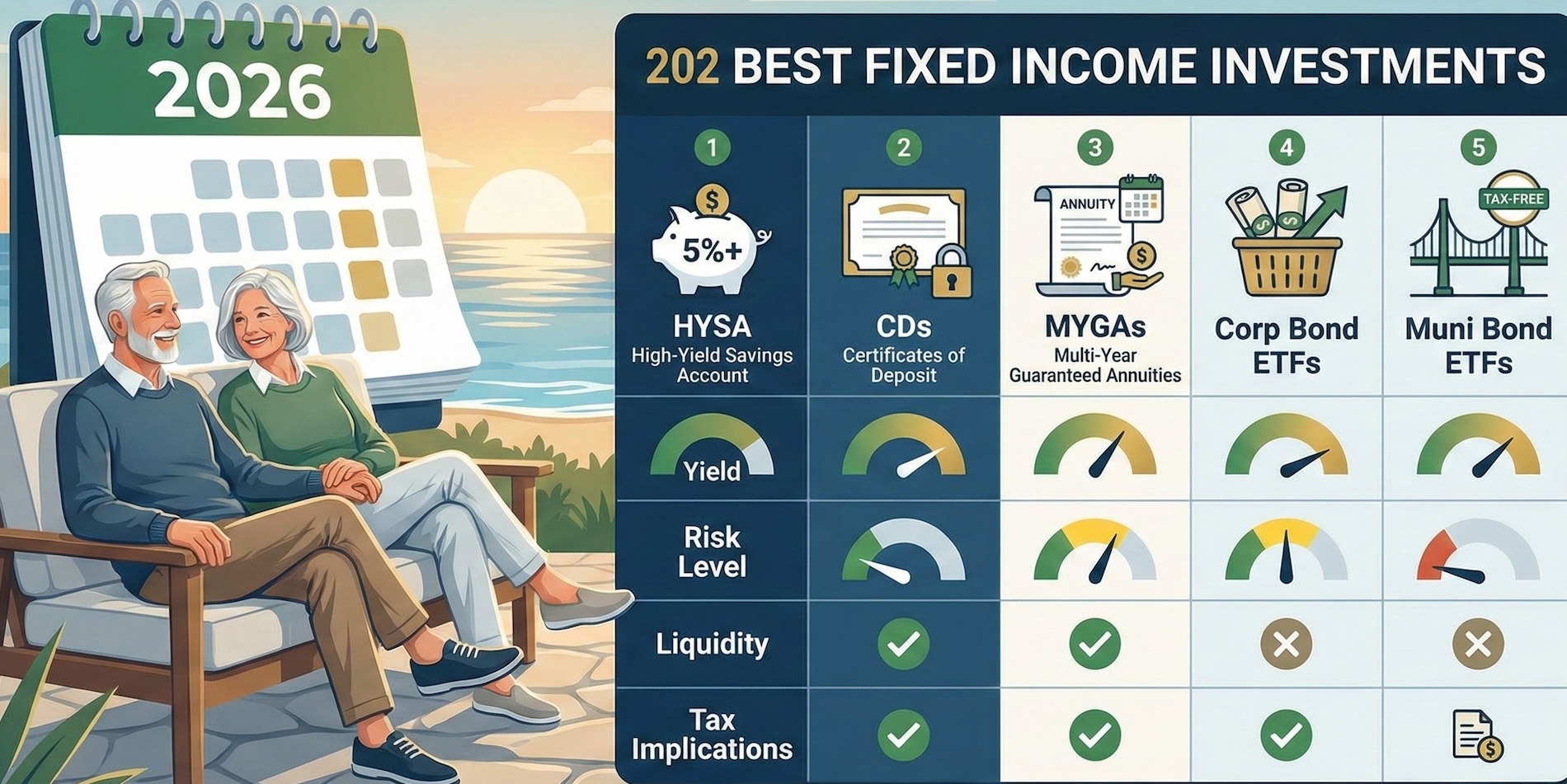
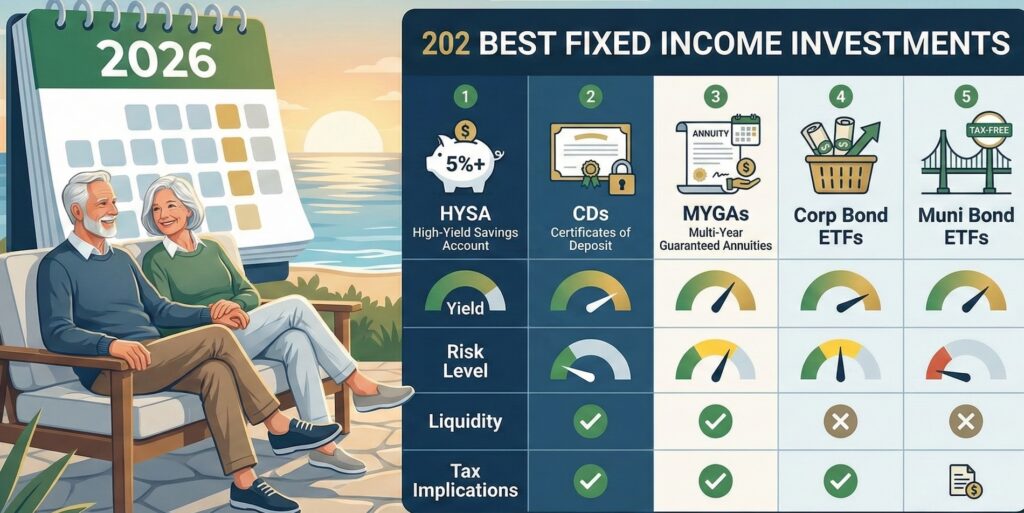
[TABLE] Fixed Income Comparison for 2026
| Investment Type | Typical Yield | Principal Risk | Liquidity | Tax Treatment |
|---|---|---|---|---|
| High-Yield Savings (HYSA) | Low to Moderate | Very Low (FDIC Insured) | Very High | Taxable as ordinary income |
| Certificates of Deposit (CDs) | Moderate | Very Low (FDIC Insured) | Low to Medium (Penalties for early withdrawal) | Taxable as ordinary income |
| Multi-Year Guaranteed Annuities (MYGAs) | Moderate to High | Very Low (State Guaranty Assoc.) | Very Low (Surrender charges apply) | Tax-deferred growth |
| Corporate Bond ETFs | Moderate | Low to Medium (Interest rate & credit risk) | High (Can be sold daily) | Taxable as ordinary income |
| Municipal Bond ETFs | Low to Moderate | Low to Medium (Interest rate & credit risk) | High (Can be sold daily) | Often exempt from federal income tax |
1. High-Yield Savings Accounts (HYSAs)
This is your financial home base. HYSAs, typically offered by online banks, provide significantly higher interest rates than traditional brick-and-mortar savings accounts. They are the ideal place for your emergency fund and any cash you need to access within the next year.
Best for: Liquidity and safety. Your funds are FDIC-insured up to $250,000, making them one of the safest places for your cash. While they offer a better yield than a standard account, their main purpose isn’t growth, but accessibility and security.
2. Certificates of Deposit (CDs)
A CD is a straightforward deal with a bank: you agree to lock up a sum of money for a specific term (e.g., 1, 3, or 5 years), and in exchange, the bank gives you a guaranteed, fixed interest rate that is typically higher than an HYSA’s.
Best for: Locking in a guaranteed return for a specific time horizon. If you know you won’t need a portion of your cash for two years, a 2-year CD can provide a better return than an HYSA with the same FDIC-insured safety. The primary drawback is the penalty for early withdrawal.
3. Multi-Year Guaranteed Annuities (MYGAs)
A MYGA is an insurance product that functions like a CD but often offers a higher interest rate. You give a lump sum to an insurance company, and it guarantees a fixed interest rate for a set term (typically 3 to 10 years). The question of cd rates vs annuity rates 2026 will likely favor annuities for those who can afford lower liquidity.
Best for: Tax-deferred growth and locking in high, guaranteed rates for the medium term. The interest you earn grows tax-deferred, meaning you don’t pay taxes on it until you withdraw it. This makes MYGAs a powerful tool for a portion of your retirement funds you don’t need to touch right away. Safety is backed by the insurance company’s financial strength and state guaranty associations, not the FDIC.
4. High-Quality Corporate Bond ETFs
Instead of lending money to one company, a corporate bond ETF allows you to lend a tiny amount of money to hundreds of large, established U.S. companies (like Apple, Johnson & Johnson, etc.). This diversification dramatically reduces the risk of a single company defaulting.
Best for: Portfolio diversification and a higher potential income than government bonds. Look for funds that focus on “investment-grade” corporate bonds, which are issued by the most financially stable companies. While very safe, be aware of “interest rate risk”—if rates go up, the value of existing bonds can go down. However, for a long-term income-seeker, these funds provide a steady stream of monthly payments.
5. Municipal Bond ETFs
Often called “munis,” these are funds that lend money to state and local governments to fund projects like schools, bridges, and hospitals. Their superpower is their tax treatment.
Best for: High-income retirees seeking tax efficiency. The interest earned from municipal bonds is often completely exempt from federal income tax. If you live in the state that issued the bond, it may be free from state and local taxes, too. For those in higher tax brackets, the tax advantages of municipal bonds mean that a 4% tax-free yield can be equivalent to a 6% or 7% taxable yield.
Conclusion: Building Your 2026 Income Strategy
So, what is the single best fixed income investment for 2026? The answer is that there isn’t one. The most resilient and effective retirement income strategy is a blend of these tools, tailored to your specific needs.
Your portfolio might use an HYSA for immediate cash, a CD or MYGA to lock in a guaranteed rate on a portion of your principal, and a mix of corporate and municipal bond ETFs for diversified, tax-efficient monthly income. By understanding the unique role of each instrument, you can move beyond a simple savings account and construct a sophisticated, multi-layered portfolio that provides what every retiree seeks: security, predictability, and peace of mind.
This article is for informational purposes only and should not be considered financial advice. Consult with a qualified financial professional to determine a strategy that is right for your individual circumstances.