Beyond Growth: 3 Big Tech Stocks Forecasted to Become Dividend Powerhouses by 2026
For decades, the investment narrative surrounding Big Tech has been singular: relentless, explosive growth. Investors bought tech stocks for capital appreciation, not for sleepy dividend checks. But the landscape is undergoing a seismic shift. The disruptive startups of yesterday have become the dominant, cash-generating empires of today. This maturity marks a new chapter, one where the focus pivots from pure growth to total return, and reliable shareholder payouts are no longer an afterthought but a core strategy.
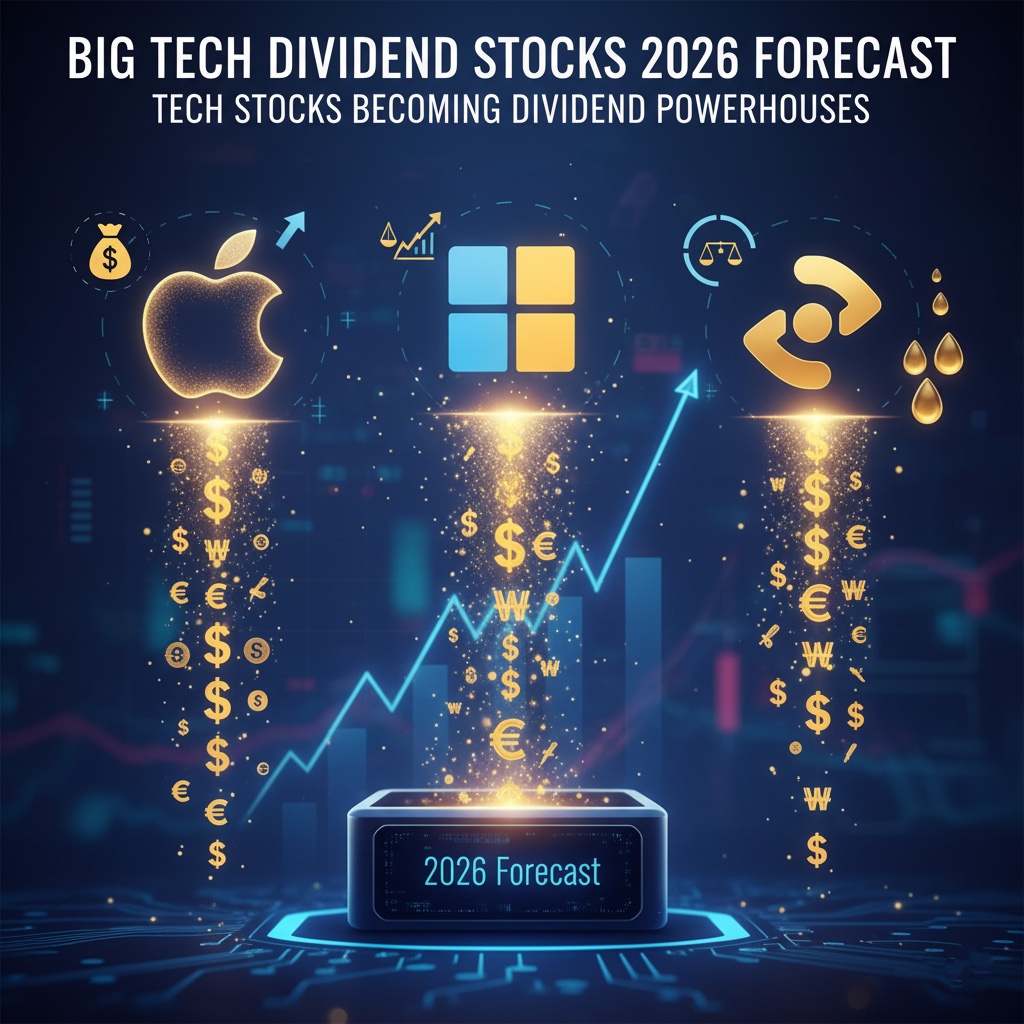
This article moves beyond the headlines to analyze the financial bedrock of this transition. We will dissect three tech titans—Microsoft, Apple, and Broadcom—not by their future promises, but by their current ability to generate and distribute massive amounts of cash. By focusing on the metrics that truly matter for income investors, we will forecast which of these giants are poised to become the dividend powerhouses of 2026 and beyond.
The Great Transition: From Cash Hoarders to Cash Dispensers
Every successful company follows a natural lifecycle. In its youth, it reinvests every dollar of profit back into the business to fuel expansion—hiring, R&D, market penetration. This is the hyper-growth phase. However, once a company achieves market dominance, its ability to generate cash often outpaces its need for reinvestment. At this point, mature, shareholder-focused management begins to return that excess capital to its owners.
“The transition from a growth-at-all-costs mindset to a balanced approach of growth and shareholder returns is the hallmark of a company that has truly arrived. It signals confidence in the durability of its business model.”
This is the story of tech stocks with growing dividends. They represent the best of both worlds: continued leadership in innovation coupled with a new, disciplined approach to rewarding long-term investors. To identify these future dividend champions, we must look beyond the stock price and analyze the engine room of their financial statements.
The Dividend Investor’s Trinity: 3 Metrics That Reveal the Truth
To assess the reliability and growth potential of a company’s dividend, we use a three-pronged approach known as the Dividend Investor’s Trinity. This framework is essential for any serious free cash flow analysis for dividends.
1. Free Cash Flow (FCF): The Lifeblood of Payouts
What it is: The cash a company generates after accounting for all operating expenses and capital expenditures (the investments needed to maintain and grow the business).
Why it matters: FCF is the pure, spendable cash that a company can use for dividends, share buybacks, or acquisitions. A company with strong and growing FCF has a powerful, sustainable source for its dividend payments. It isn’t just an accounting profit; it’s real cash in the bank.
2. Payout Ratio: The Sustainability Gauge
What it is: The percentage of a company’s earnings or FCF that is paid out to shareholders as dividends.
Why it matters: A low payout ratio (e.g., under 50%) indicates a significant safety cushion. The company can easily cover its current dividend and has ample room to increase it in the future. A ratio approaching 100% could be a warning sign that the dividend is at risk during a business downturn, making it a crucial metric for finding safe dividend stocks 2026.
3. Dividend Growth History: The Track Record of Trust
What it is: The company’s history of increasing its dividend payment year after year.
Why it matters: A consistent track record of dividend growth is one of the strongest signals management can send about its confidence in the company’s future prospects. It demonstrates a long-term commitment to rewarding shareholders.
The 2026 Dividend Powerhouse Forecast
Using our trinity framework, let’s analyze our three candidates.
1. Microsoft (MSFT)
As a dominant force in enterprise software and cloud computing (Azure), Microsoft is a cash-generation machine. Its transition to a subscription model provides a predictable and growing revenue stream.
- Free Cash Flow: Consistently generates tens of billions in FCF per quarter. Its cloud business growth ensures this trend will likely continue.
- Payout Ratio: Remains comfortably low, typically in the 25-30% range. This demonstrates exceptional Microsoft dividend safety and leaves massive room for future increases.
- Dividend Growth: Has a stellar track record of double-digit percentage increases to its dividend for over a decade.
Forecast: Microsoft is the quintessential tech dividend powerhouse. Expect steady, high-single-digit or low-double-digit dividend growth to continue through 2026, making it a core holding for any tech-focused income portfolio.
2. Apple (AAPL)
While its dividend yield is modest, Apple’s financial strength is unparalleled. Its fortress balance sheet and the immense loyalty of its ecosystem make its cash flow incredibly resilient.
- Free Cash Flow: Apple generates more FCF than almost any company in history. The Services division, with its high-margin recurring revenue, adds further stability.
- Payout Ratio: The payout ratio is extremely low, often below 20%. Apple prioritizes share buybacks but could easily double its dividend without financial strain.
- Dividend Growth: Apple has consistently raised its dividend every year since reinitiating it in 2012. The Apple dividend growth forecast remains strong, even if the increases are measured.
Forecast: Apple will remain a reliable, if not spectacular, dividend grower. Its safety is unquestionable. The key catalyst for 2026 would be a strategic decision to allocate more of its cash flow toward dividends instead of buybacks.
3. Broadcom (AVGO)
A leader in semiconductor and infrastructure software, Broadcom has pursued an aggressive strategy of acquisition and shareholder returns.
- Free Cash Flow: Known for its rigorous operational efficiency, Broadcom converts a very high percentage of its revenue into FCF.
- Payout Ratio: Historically has aimed for a payout ratio around 50% of its prior year’s FCF, a disciplined and transparent policy.
- Dividend Growth: Has one of the most explosive dividend growth records in the entire market over the last decade, though this pace is naturally slowing as the dividend base grows.
Forecast: Broadcom offers a much higher starting yield than Microsoft or Apple, representing a more mature dividend policy. For 2026, expect growth to moderate to high-single-digits, but it will remain a powerful income generator, blending tech exposure with a substantial and secure payout.
Conclusion: The New Face of Total Return
The narrative is clear: the most dominant names in technology are no longer just growth stocks. They are evolving into the blue-chip dividend payers of the modern economy. By analyzing them through the lens of free cash flow, payout ratios, and dividend history, investors can identify the companies that offer a compelling blend of stability, income, and continued growth potential.
As we look to 2026, the concept of “total return”—the combination of capital appreciation and dividend income—is the new benchmark for evaluating Big Tech. Microsoft, Apple, and Broadcom are at the forefront of this evolution, proving that investing in the future doesn’t have to mean sacrificing income today. For those building a resilient, long-term portfolio, these dividend powerhouses represent a strategic and intelligent choice.
This article is for informational purposes only and should not be considered financial advice. For a personalized investment strategy, consider consulting with a qualified financial advisor.