From Passion to Profit: A 5-Step Framework for Turning Your Hobby into a Real Side Hustle
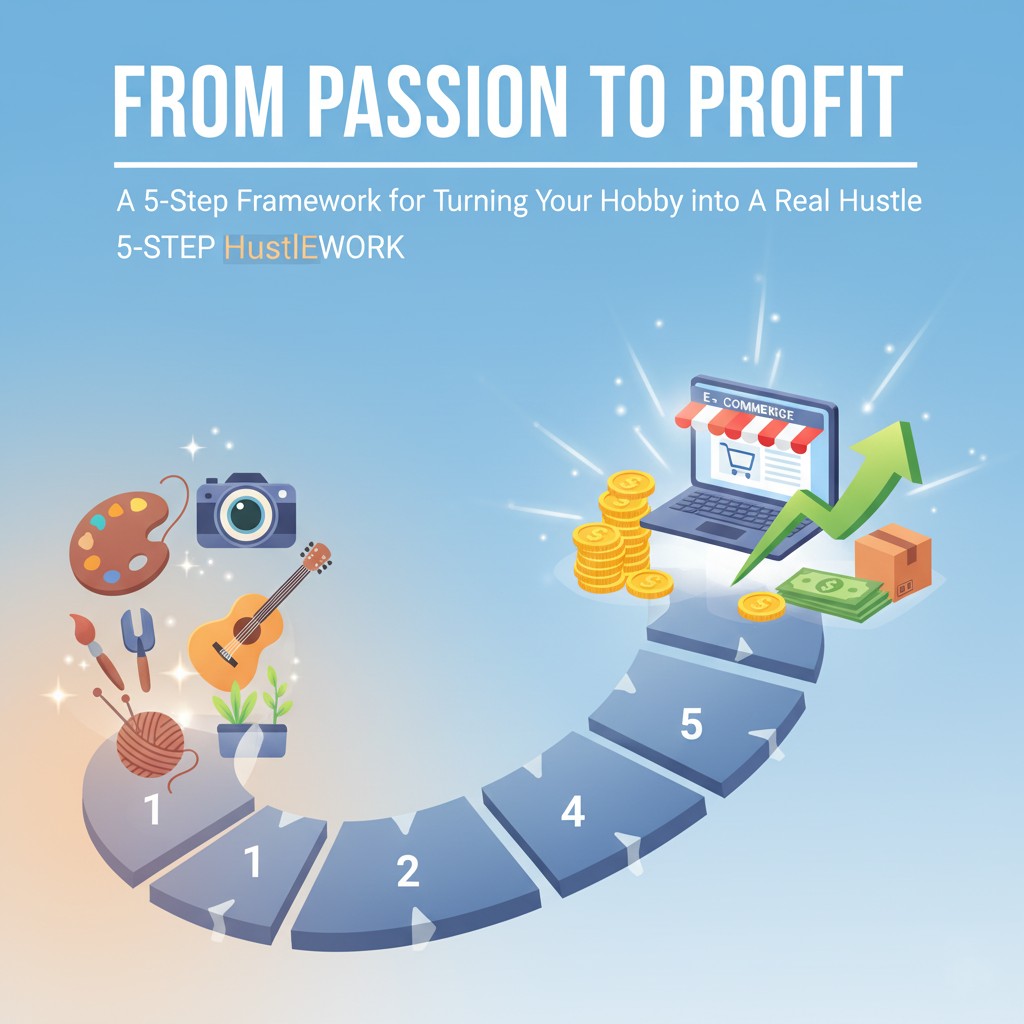
Someone has almost certainly told you, “You’re amazing at baking/painting/woodworking! You should totally sell that.” It’s one of the best compliments a hobbyist can receive. It sparks a flicker of excitement, followed swiftly by a wave of quiet panic. Where would you even begin? The gap between creating for joy and selling for profit can feel like a vast, intimidating chasm.
But what if it isn’t a giant leap? What if it’s a series of small, manageable steps? This guide is your bridge across that chasm. We will provide a clear, 5-step framework designed to take your passion project and methodically turn it into a real, income-generating side hustle, without the overwhelm.
The Crucial Mindset Shift: From Hobbyist to Entrepreneur
Before we dive into the practical steps, let’s address the most significant hurdle: the mental one. A hobby is a form of self-expression; a business is a service to others.
- A hobby is a monologue: You create what you want, when you want. The process is the reward.
- A business is a dialogue: You create what a customer wants and is willing to pay for. The solution you provide is the reward—for both of you.
This doesn’t mean sacrificing your passion. It means channeling it to solve someone’s problem, whether that problem is finding a unique birthday gift, a delicious weekend dessert, or a custom piece of code. Embracing this shift from personal project to customer solution is the foundational first step.
“The moment you decide to sell your creation, you are no longer just an artist or a maker. You are an entrepreneur. Act like one from day one.”
The 5-Step Framework: Your Path from Passion to Profit
Here is the exact framework to guide your journey. Don’t move to the next step until you’ve completed the one before it.
Step 1: Validate Your Idea (Before You Invest a Dime)
This is the most critical step that 90% of aspiring side hustlers skip. Do not build a website, do not order 500 business cards, and do not incorporate an LLC. First, you must answer one question: Will someone actually pay for this?
The “if you build it, they will come” mentality is a recipe for a garage full of unsold inventory. Instead, create a Minimum Viable Product (MVP).
- Case Study: The Weekend Baker. Sarah loved baking elaborate cakes. Instead of launching a full menu, her MVP was one perfect “Celebration Cake.” She baked two, took beautiful photos with her phone, and posted them on her personal Instagram and local town Facebook group. She asked, “I’m thinking of selling these locally for weekend events. Any interest?” Within a day, she had three inquiries. Her idea was validated.
Your goal here isn’t to make a fortune; it’s to get a clear signal that a market exists for your passion.
Step 2: Define Your Product & Service
With validation in hand, it’s time to move from a general hobby to a specific, sellable offering. “I sell paintings” is a hobby. “I sell custom 8×10 watercolor pet portraits” is a product.
- Create a Simple ‘Menu’: Start with a very limited menu of 1-3 offerings. This simplifies your process, makes it easier for customers to choose, and prevents you from getting overwhelmed.
- Example: The woodworker moves from “I make things with wood” to offering “1. Custom Engraved Coasters (Set of 4), 2. Hand-carved Serving Spoons, 3. Small Bookshelf (Local Pickup Only).”
Clarity is kindness, both for you and your customers.
Step 3: Build Your Digital ‘Storefront’
You need a place for customers to see your work and give you money. You have two main paths, each with pros and cons.
- Marketplaces (like Etsy):
- Pros: Huge, built-in audience of buyers searching for products like yours. Easy to set up.
- Cons: High competition, transaction fees, and you’re building your brand on “rented land.”
- Best For: Handmade physical goods, art, and crafts.
- Your Own Website (using Shopify or Squarespace):
- Pros: Complete control over your brand, no direct competition, higher profit margins.
- Cons: You are responsible for 100% of your traffic. It’s a longer-term play.
- Best For: Building a sustainable, long-term brand. You can start with a simple one-page site. .
Step 4: Price Your Work for Profit
This is where many hobbyists fail. They price their work based on emotion or material cost alone, completely forgetting their most valuable asset: their time.
Use this simple, foundational formula to find your baseline:
(Cost of Materials + (Your Desired Hourly Rate x Hours to Create)) x 2 = Retail Price
If a painting takes $20 in materials and 4 hours of your time at a modest $25/hour, your cost is $120. Your starting retail price should be $240. You can adjust from there, but never undervalue your labor. For a more detailed breakdown, see our .
Step 5: Land Your First 3 Customers
With your product, storefront, and pricing in place, it’s time for the moment of truth. The goal here is momentum and testimonials.
- 1. Friends & Family (The Right Way): Announce your launch and offer a special “friends and family” introductory price. Treat them like real customers: send an invoice, deliver professionally, and ask for an honest review you can share.
- 2. Your Local Community: Post in relevant local Facebook groups, on Nextdoor, or put up a flyer at a local coffee shop. Emphasize that you’re a local maker.
- 3. Your Existing Social Network: Craft a “launch day” post for your personal social media. Be proud! Share your story, your product, and a direct link to your new storefront.
Conclusion
The journey from a beloved hobby to a profitable side hustle is not a single, terrifying leap but a sequence of deliberate, logical steps. It begins not with a huge investment, but with a simple question: “Will someone buy this?” From that first validation, you define your product, build your storefront, price for profit, and find your first customers.
The secret shared by every successful entrepreneur is that they started before they felt 100% ready. They embraced the dialogue with their customers and learned by doing. Your passion has value. This framework is your permission slip to unlock it.
This article is for informational purposes only and should not be considered financial advice.