Is Your 401(k) Off-Kilter? A 5-Step Guide to Rebalancing Your Portfolio for 2026
For millions, the 401(k) is the cornerstone of their retirement strategy. You diligently contribute from each paycheck, select your funds, and then… you let it be. This “set and forget” approach feels responsible, but over time, market forces can silently steer your financial ship off course. A portfolio that was perfectly balanced for your risk tolerance two years ago may now be exposing you to far more risk than you realize. This phenomenon is called portfolio drift, and it’s one of the most common and overlooked risks in retirement planning.
As 2025 draws to a close, it’s the perfect time for a financial check-up. Rebalancing your 401(k) is a simple act of financial hygiene, like a captain adjusting the rudder to stay on a true course toward their destination. It’s not about timing the market; it’s about managing risk. This guide will demystify the process, providing a simple, 5-step walkthrough to ensure your 401(k) is properly calibrated for the journey to 2026 and beyond.
What is Portfolio Rebalancing (and Why Does It Matter)?
Imagine you are tending a garden. You’ve planted 60% vegetables (stocks, for growth) and 40% sturdy perennials (bonds, for stability). After a season of fantastic sun and rain, the vegetable plants have grown twice as large, while the perennials have grown more slowly. Your garden is now 75% vegetables and 25% perennials. It looks impressive, but you’re now far more vulnerable to a sudden pest or drought (a market downturn). Rebalancing is simply the act of trimming back some of the overgrown vegetables and using the harvest to plant more perennials, bringing your garden back to its intended 60/40 balance.
In investment terms, rebalancing is the process of selling some assets that have performed well and buying more of the assets that have underperformed to return to your original target asset allocation. It enforces a disciplined “buy low, sell high” strategy and, most importantly, ensures your portfolio’s risk level doesn’t creep up without your consent.
“The primary goal of rebalancing is not to maximize returns, but to manage risk. It’s the disciplined execution of your original investment strategy.”
Before You Start: Know Your Target Allocation
You can’t rebalance if you don’t know what you’re aiming for. Your target allocation is the ideal mix of stocks, bonds, and other assets based on your age, risk tolerance, and time until retirement. A common rule of thumb is the “110 minus your age” rule for stock allocation (e.g., a 40-year-old might have 110 – 40 = 70% in stocks). Many 401(k) providers offer questionnaires to help you determine a suitable mix. This is a critical first step in understanding your proper 401k allocation by age.
The 5-Step Guide to Rebalancing Your 401(k)
Here is a simple walkthrough of how to rebalance using a typical 401(k) provider’s website.
Step 1: Log In and Locate Your Holdings
Log into your 401(k) account. Once on the main dashboard, look for a tab or link labeled “Positions,” “Holdings,” “Investments,” or “Asset Allocation.” This will show you the specific funds you own and how much you have in each.
Step 2: Review Your Current Allocation
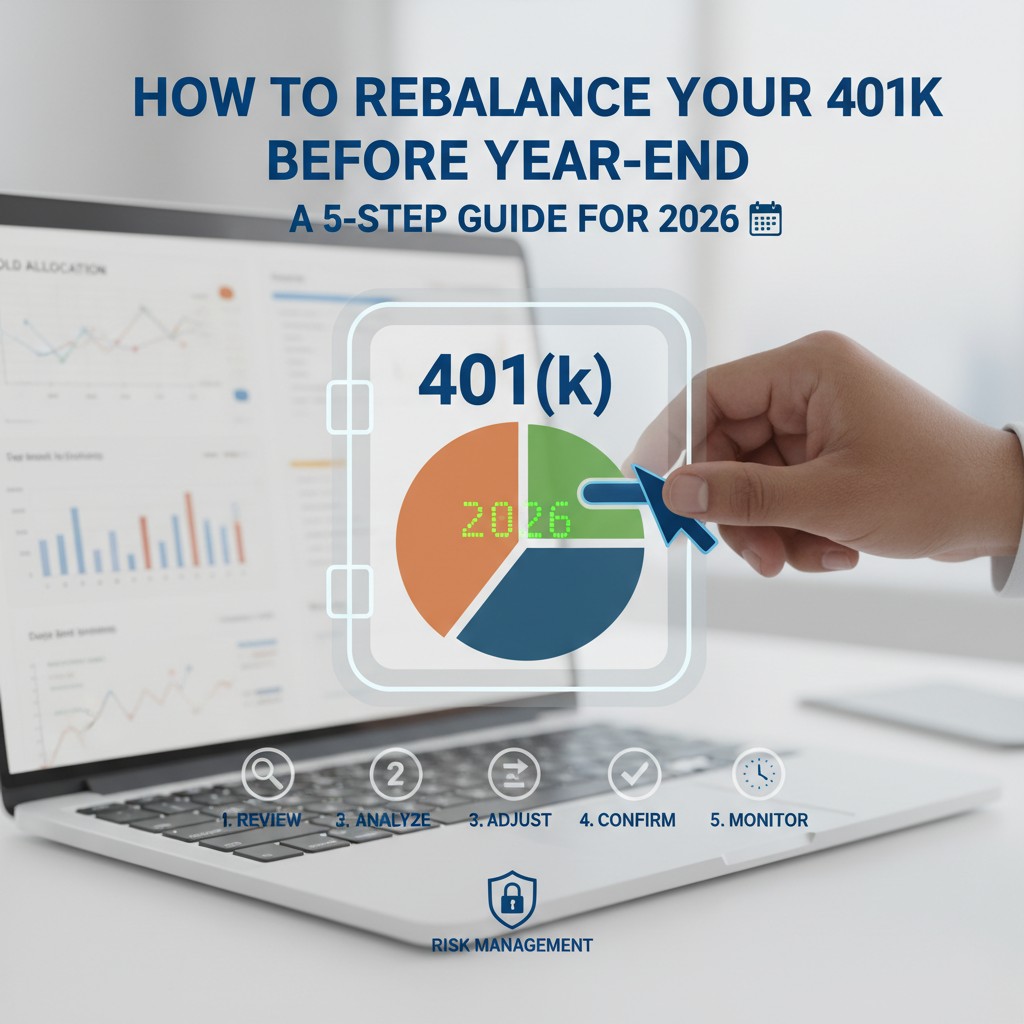
On that page, you should see a summary of your portfolio, often with a pie chart, showing your current asset mix (e.g., 72% U.S. Stocks, 18% International Stocks, 10% Bonds). Add up the stock portions to get your total stock allocation. In this example, it’s 90% stocks.
Step 3: Compare to Your Target Allocation
Let’s say your target, based on your age and risk tolerance, is 75% stocks and 25% bonds. Your current 90% stock allocation is significantly more aggressive than your intended strategy. You are “off-kilter” and exposed to more risk than you planned for.
Step 4: Execute the Rebalance
You have two main options here. The best and easiest is to look for a button or link that says “Rebalance” or “Manage My Portfolio.” Most major 401(k) providers have a tool that automates this process for you. It will ask for your desired percentages and then execute all the necessary trades in the background to get you back to your target. This is the recommended method.
Alternatively, you would have to manually calculate how much of your overgrown funds to sell and which underperforming funds to buy. This is complex and not recommended for most people. Many plans also offer an automatic rebalancing 401k feature, which you can set to run quarterly or annually. This is a fantastic “set and remember” feature.
Step 5: Set a Reminder for Next Year
Rebalancing isn’t a one-time fix. It’s an ongoing process. Set a calendar reminder to review your 401(k) at least once a year. A year-end review is a popular and easy-to-remember tradition. This answers the question of how often to rebalance 401k for most long-term investors.
A Special Note on Target-Date Funds
What if you look at your holdings and see 100% of your money is in a single fund, like a “Retirement 2050 Fund”? This is a Target-Date Fund (TDF). The good news is that a TDF automatically rebalances for you. It also gradually becomes more conservative as you approach your retirement date. If you are using a TDF, you don’t need to manually rebalance. This is the simplest solution for investors who prefer a hands-off approach and is a key point of comparison in the target date fund vs rebalancing debate.
Conclusion: The Power of a Simple Check-Up
Your 401(k) is a powerful engine for wealth creation, but it requires occasional maintenance. Rebalancing is not a complicated, high-finance maneuver; it is a simple, disciplined action that keeps your investment strategy aligned with your long-term goals. By taking 30 minutes at the end of the year to perform this check-up, you are not just managing your portfolio—you are taking active control of your financial future. You are being a prudent captain, ensuring your ship is pointed directly toward the shores of a comfortable retirement.
This article is for informational purposes only and should not be considered financial advice.