Roth vs. Traditional IRA: The No-Nonsense Guide for Investors Under 30
As a young professional, you’re told to save for retirement. It’s a mantra you hear so often it becomes background noise. But when you finally decide to act, you’re hit with a seemingly simple choice that feels impossibly complex: Should you open a Roth IRA or a Traditional IRA? This isn’t just financial jargon; it’s one of the most consequential financial decisions you’ll make in your 20s, with implications stretching decades into your future.
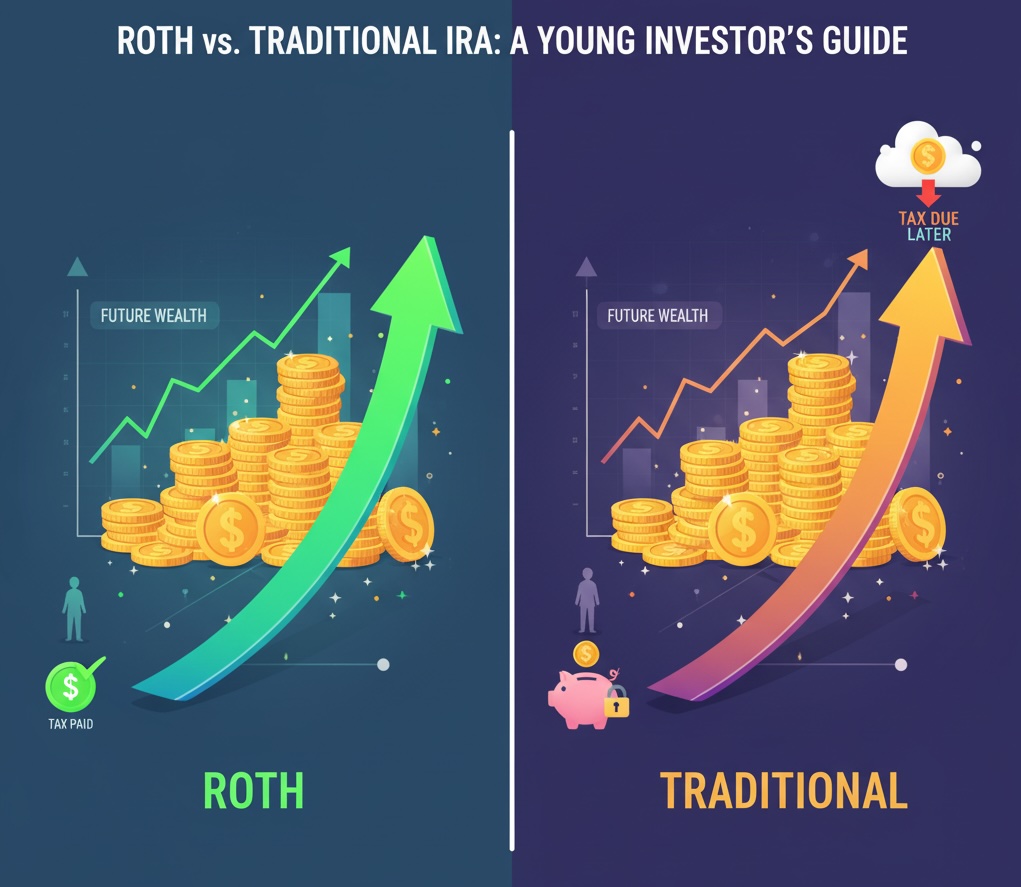
The choice boils down to a single, critical question: Would you rather pay taxes now or pay taxes later? One path offers immediate gratification in the form of a tax break, while the other promises a future of tax-free wealth. For an investor under 30, with a long career runway ahead, the correct answer could be worth hundreds of thousands of dollars. This guide will demystify the debate and give you a clear framework to make the optimal choice.
The Core Concept: Pay Now or Pay Later?
Before we dive into the numbers, let’s simplify the concept with an analogy.
Imagine two all-inclusive resort packages.
- The Traditional IRA is the “Pay Later” package. You pay a lower price to get into the resort today (your upfront tax deduction), but you have to pay for all your drinks and meals when you check out, 40 years from now (taxes on withdrawals in retirement).
- The Roth IRA is the “Pay Now” package. You pay the full, standard price today (you contribute with post-tax dollars), but every single thing—every meal, every drink, every activity—is completely free for your entire stay (tax-free growth and withdrawals).
Which is the better deal? It depends entirely on whether the price of those meals and drinks goes up or down in the future.
A Tale of Two Investors: The 40-Year Race to Retirement
Let’s meet our two investors: Roth Rachel and Traditional Tom. Both are 25, earn $60,000 a year, and are in the 22% federal tax bracket. Each decides to invest $6,000 into an IRA. For simplicity, we’ll assume their investments earn a steady 7% annual return until they retire at age 65.
Roth Rachel’s Path: The Power of Tax-Free Growth
Rachel contributes her $6,000. Since it’s a Roth IRA, this money is post-tax; she gets no immediate tax break. Her $6,000 is invested and begins to grow. The magic happens at retirement: every penny she withdraws—both her original contributions and the massive growth over 40 years—is 100% tax-free.
Traditional Tom’s Path: The Allure of the Upfront Deduction
Tom also contributes $6,000. But because he chose a Traditional IRA, he can deduct that contribution from his taxable income. This traditional ira tax deduction saves him $1,320 today (22% of $6,000). It feels like an instant win. His $6,000 also grows for 40 years. However, when he retires, every dollar he withdraws will be taxed as ordinary income.
The Great Unveiling: Which Account Wins?
This is where the power of forecasting comes in. The winner of the roth ira vs traditional ira debate depends almost entirely on one variable: your tax rate in retirement compared to your tax rate today.
Scenario 1: Tax Rates Rise in the Future
Let’s assume Rachel and Tom are successful. By the time they retire, they are in a higher tax bracket, say 25%.
- Roth Rachel (at 65): Her initial $6,000 has grown to approximately $89,849. She withdraws it all, tax-free. Her take-home amount: $89,849.
- Traditional Tom (at 65): His account has also grown to $89,849. But when he withdraws it, it’s taxed at 25%. He owes $22,462 in taxes. His take-home amount: $67,387.
In a future with higher taxes, the Roth IRA is the undisputed champion.
Scenario 2: Tax Rates Fall in the Future
Now, let’s assume life is less predictable. Perhaps Tom and Rachel decide to live a simpler life in retirement, and their income puts them in a lower tax bracket, say 15%.
- Roth Rachel (at 65): Her outcome is the same. Her take-home amount: $89,849.
- Traditional Tom (at 65): His account is worth $89,849. It’s now taxed at only 15%. He owes $13,477 in taxes. His take-home amount: $76,372.
Even in this scenario, the Roth IRA still yields a higher net return. Tom did get that $1,320 tax break 40 years ago, but it wasn’t enough to overcome the power of completely tax-free growth.
Key Takeaway Box:
The decision hinges on your expected future income.
- Expect to earn more and be in a higher tax bracket in retirement? The Roth IRA is almost certainly the better choice. Pay the lower tax rate now.
- Expect to earn less and be in a lower tax bracket in retirement? The Traditional IRA becomes more attractive, as the upfront tax deduction is more valuable.
For most young investors, whose careers and incomes are just beginning to ramp up, the bet on a higher future tax bracket is a logical one.
Other Important Rules of the Road
While the tax treatment is the main event, there are other factors to consider.
| Feature | Roth IRA | Traditional IRA |
|---|---|---|
| Contribution Limit (2025) | $7,000 (under 50) | $7,000 (under 50) |
| Tax Deduction | No | Yes (if within income limits) |
| Tax on Growth | Tax-Free | Tax-Deferred |
| Tax on Withdrawals | Tax-Free | Taxed as income |
| Withdrawal of Contributions | Can be done anytime, tax and penalty-free | Taxable and penalized before 59.5 |
| Required Minimum Distributions | No | Yes, starting at age 73 |
The ability to withdraw your contributions (not earnings) from a Roth IRA at any time without penalty makes it a more flexible vehicle, acting as a potential backup emergency fund. For official rules and the latest roth ira contribution limits, always consult the official IRS website.
Conclusion: Place Your Bet on Your Own Success
So, should I open a roth or traditional ira? For the vast majority of investors under 30, the Roth IRA is the more powerful tool. By choosing to pay taxes now, while you are likely in one of the lowest tax brackets of your career, you are buying yourself a future of tax-free income. It is, in essence, a bet on your own future success.
The Traditional IRA has its place, particularly for those who are in their peak earning years and need the immediate tax deduction. But as an ira for beginners, the simplicity and profound long-term tax advantages of the Roth IRA are hard to beat.
The next step is to take action. Explore the best ira accounts for young adults from reputable, low-cost brokerage firms. By making a smart choice today, you are setting the stage for a wealthier, more secure retirement tomorrow.
This article is for informational purposes only and should not be considered financial advice.