The Safest High-Yield Investments for Retirees in 2025 (Top 5 Fixed-Income Options)
For over a decade, retirees navigated a financial world of near-zero interest rates, a frustrating landscape where safe investments yielded next to nothing. Today, the tables have turned. The Federal Reserve’s campaign against inflation has ushered in the most attractive environment for fixed-income investors in recent memory. But with this opportunity comes a critical question: How do you seize these high yields without exposing your nest egg to unnecessary risk?
If you are living in or nearing retirement, your primary financial goal shifts from aggressive growth to capital preservation in retirement. Yet, with inflation as a persistent concern, simply preserving capital isn’t enough. You need it to generate a reliable income stream. This guide cuts through the noise to analyze the five safest high-yield fixed-income options for 2025, helping you build a resilient and profitable retirement portfolio.
1. The Liquid Foundation: High-Yield Savings Accounts (HYSAs)
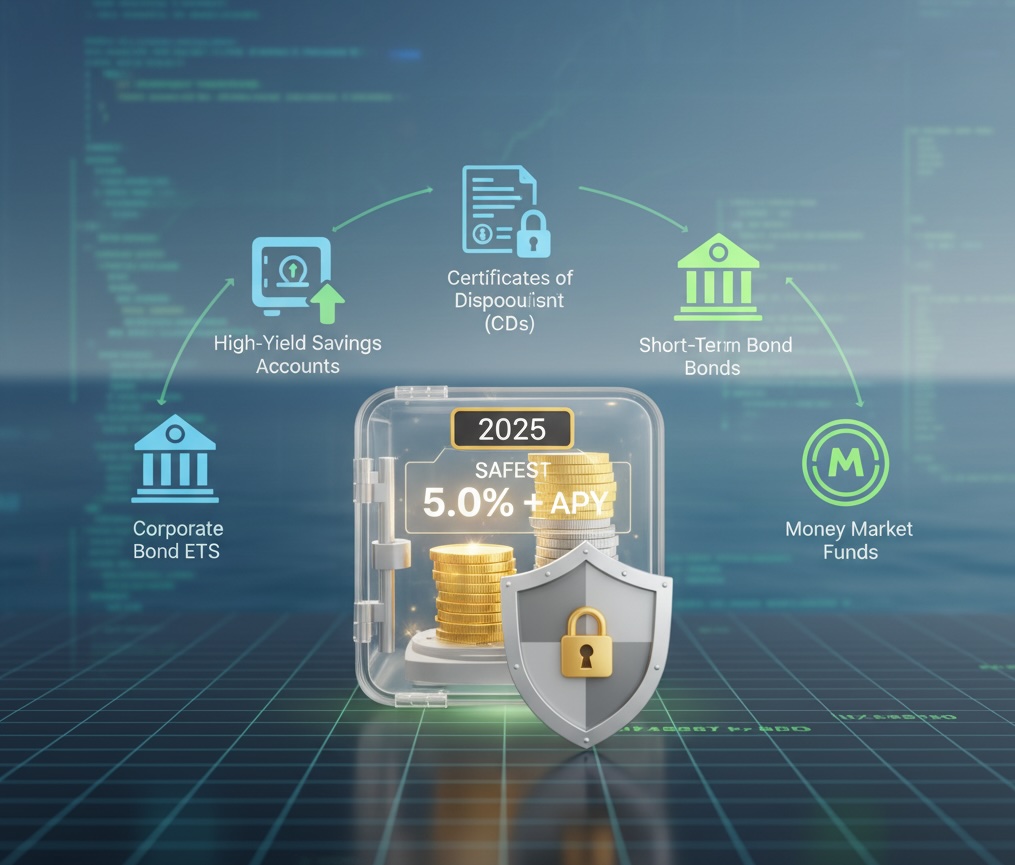
Think of an HYSA as the bedrock of your cash reserves. In the high-rate environment of 2025, these accounts have transformed from sleepy parking lots for cash into powerful income-generating tools. Unlike traditional savings accounts, HYSAs offered by online banks and credit unions provide annual percentage yields (APYs) that can often compete with, or even surpass, inflation.
The primary appeal of HYSAs lies in their trifecta of benefits: competitive returns, ironclad safety, and immediate liquidity. This makes them the ideal home for your emergency fund and any cash you’ll need in the next 6-12 months.
For retirees, the search for high-yield savings accounts for seniors should focus on FDIC (or NCUA for credit unions) insurance, which protects up to $250,000 per depositor, per institution. There are no market risks, no fluctuating principal—just a predictable return on your cash. While the rates are variable and will decrease if the Fed cuts rates, they provide an unparalleled combination of safety and access.
2. The Predictable Powerhouse: Certificates of Deposit (CDs)
If you have cash you won’t need for a specific period—say, one to five years—CDs offer a compelling step-up in yield from HYSAs. A CD is a contract with a bank where you agree to leave your money untouched for a set term in exchange for a fixed interest rate. That rate is locked in, providing a predictable and guaranteed return, immune to future rate cuts by the Fed.
For retirees who value certainty, this is a powerful tool. However, the trade-off is liquidity. Early withdrawals typically incur a penalty. This is where a sophisticated technique comes into play: the CD laddering strategy for retirement.
Strategy Spotlight: The CD Ladder
Instead of putting a large sum into a single 5-year CD, you divide it. For example, with $100,000, you could put $20,000 each into 1-year, 2-year, 3-year, 4-year, and 5-year CDs. Each year, as a CD “rung” matures, you can either use the cash or reinvest it into a new 5-year CD, continually capturing the highest long-term rates while ensuring a portion of your money becomes liquid annually.
3. The Gold Standard of Safety: Short-Term Government Bonds
When the question is, “are government bonds a good investment for retirees?”, the answer for short-term U.S. Treasury securities is an emphatic yes. Treasury Bills (T-Bills), with maturities of one year or less, are considered one of the safest investments on Earth. They are backed by the full faith and credit of the U.S. government, meaning the risk of default is virtually zero.
Unlike the interest from CDs and HYSAs, the interest earned on Treasury securities is exempt from state and local taxes, a significant benefit for retirees in high-tax states. You can purchase them directly from the government through the TreasuryDirect website or through a brokerage account. In an uncertain world, the guaranteed return and unparalleled safety of T-Bills provide profound peace of mind.
4. The Diversified Income Stream: Investment-Grade Corporate Bond ETFs
For retirees willing to take on a small, calculated amount of additional risk for a higher yield, low-risk corporate bond ETFs present an excellent solution. An ETF (Exchange-Traded Fund) is a basket of dozens or even hundreds of individual bonds, offering instant diversification that would be difficult and costly for an individual to replicate.
The key is to focus on “investment-grade” funds. These funds hold bonds from financially stable, blue-chip companies, making the risk of default on any single bond minimal and its impact on the overall fund negligible. Unlike individual bonds, ETFs are traded on an exchange like stocks, offering excellent liquidity. They provide a monthly dividend income, creating a steady “paycheck” for retirees.
Think of a corporate bond ETF as owning a small slice of the debt of America’s most reliable companies. You are effectively the lender, and these corporate giants pay you regular interest for the privilege.
5. The Inflation Fighter: Series I Savings Bonds (I-Bonds)
While not a traditional fixed-income product in the same vein as the others, I-Bonds deserve a special mention for their unique structure designed explicitly to combat inflation. The return on an I-Bond is a composite of two components: a fixed rate set at the time of purchase and an inflation-adjusted rate that changes every six months.
When inflation is high, I-Bonds can offer exceptionally attractive returns while protecting your principal. However, there are limitations: you can only purchase $10,000 per person per year electronically, and you cannot redeem them for the first year. Still, as a component of a broader retirement strategy, they are a powerful tool for preserving purchasing power.
The 2025 Retiree’s Fixed-Income Cheat Sheet
| Investment Vehicle | Primary Advantage | Best For… | Liquidity | Risk Level |
|---|---|---|---|---|
| High-Yield Savings | Safety & Liquidity | Emergency funds, near-term cash needs | Excellent | Very Low |
| Certificates of Deposit (CDs) | Guaranteed Fixed Yield | Locking in rates for 1-5 year goals | Low (Penalty for early withdrawal) | Very Low |
| U.S. Treasury Bills | Ultimate Safety & Tax Benefits | The safest portion of your portfolio | High (Active secondary market) | Extremely Low |
| Corporate Bond ETFs | Diversification & Higher Yield | Generating a monthly income stream | Excellent | Low |
| I-Bonds | Inflation Protection | Long-term preservation of buying power | Low (Locked for 1 year) | Very Low |
Conclusion: From Preservation to Intelligent Yield Generation
The financial landscape of 2025 offers a rare gift to retirees: the ability to earn a meaningful, safe return on fixed-income investments. The era of chasing yield in risky assets out of necessity is over. The new paradigm is not just about capital preservation in retirement; it’s about intelligent yield generation.
The optimal strategy is not to choose one of these options, but to blend them. Use HYSAs for your liquid cash, build a CD ladder for predictable medium-term returns, anchor your portfolio in the absolute safety of Treasuries, and supplement your income with a diversified corporate bond ETF. By layering these tools, you can construct a financial fortress—one that not only withstands economic uncertainty but also provides the steady, reliable income you need to thrive in your retirement years.
This article is for informational purposes only and should not be considered financial advice.